Q&A: We’re building a lot! Is it enough?

(Updated October 29, 2017)

A lot of homes have been built in the Seattle area lately.  Seattle famously has become number one in the country for the number of construction cranes.  For some, this has raised one or both of these questions:

Aren’t we already building enough to make housing more affordable?

Can we ever build enough to make housing more affordable?

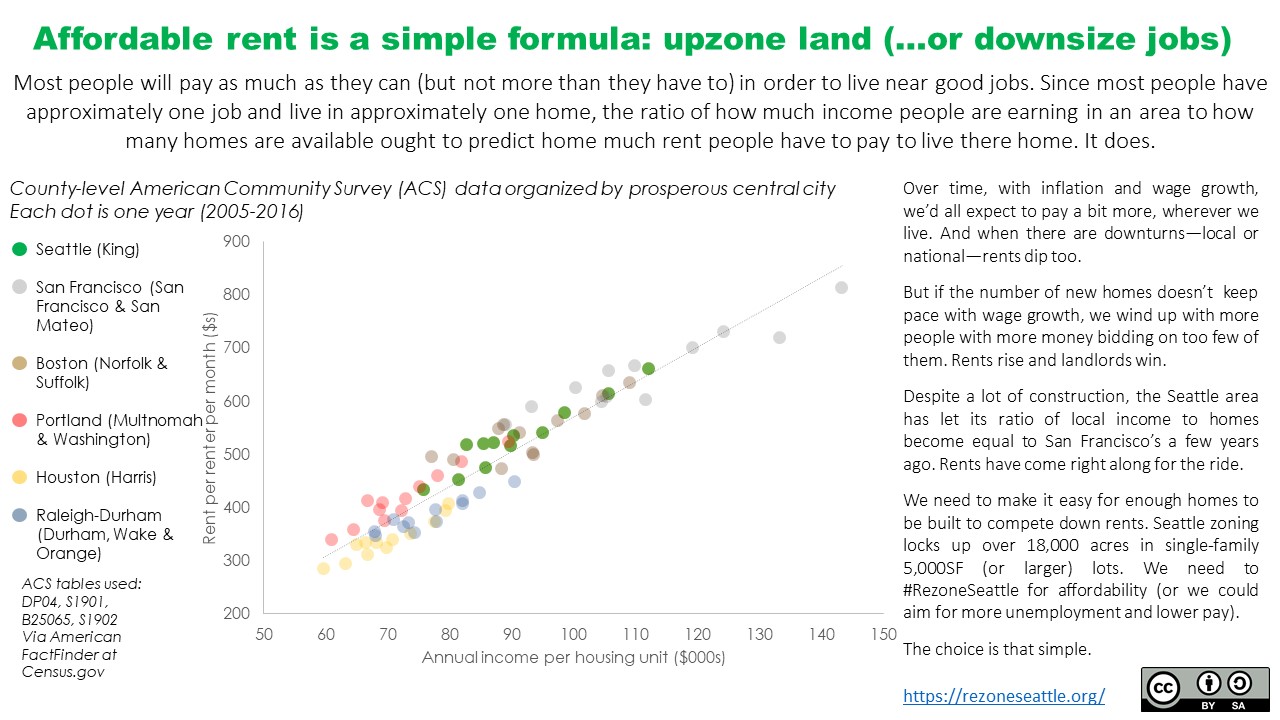
Because most of us basically need to work to live, jobs are a strong predictor of where people will move to or away from.  And because most people will pay as much as they can, but not more than they have to, for a home near a good job, income per housing unit turns our to be a strong predictor of rent per renter.  (Think about it this way: rent is what you have to bid to live near your job.  When there are fewer homes than people with good incomes bidding for them, rent goes up. Because most people have about one job, income winds up being  a good measure.)

As the Seattle Times notes, we aren’t building enough to keep up with job growth.  But we can also use income and housing data to see how many new homes would keep up with it.
wages homes rent updated

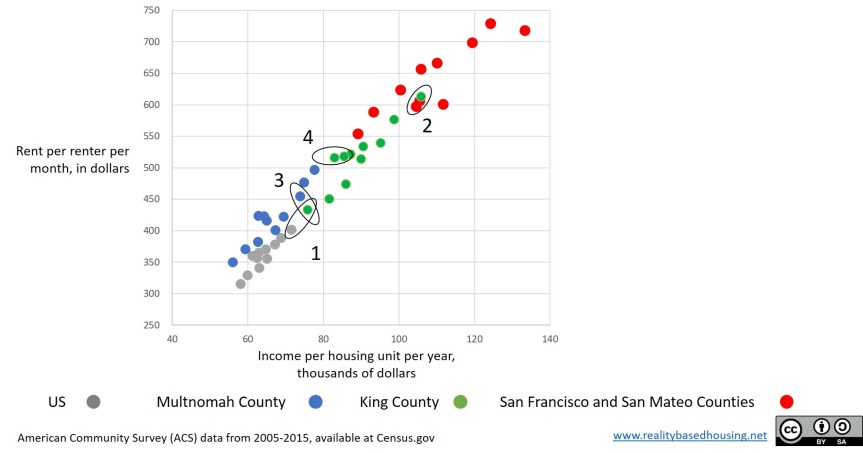
Here’s a chart showing rent per renter per month (X axis) and income per housing unit per month (Y axis) at the county level for King (Seattle and environs), Multnomah (Portland, Oregon), San Francisco and San Mateo (Silicon Valley) combined, and the US overall.  Each point represents one year from 2005-2015.
incomerent

1:   In 2005 King County’s annual income per housing unit was $76k, close to 2015’s US average of $71k. Rent per renter was $433 per renter per month, close to the 2015 US average of $402.

2:  As King reached San Francisco-style ratios of income per home, we reached San Francisco-style rents. In 2015 our income per household was $106k, matching San Francisco’s in 2009. Our 2015 monthly rent per renter was $613. Their 2009 monthly rent per renter was $606.

3:  Similarly, when Multnomah County’s income per housing unit was close to the US average, so was rent per renter. By 2014 income per housing unit ha risen to $74k, comparable to King County in 2005 ($76k). Monthly rent per renter rose to $455, close to King’s 2005 figure of $433.

4: Higher unemployment and lower wages has the same effect on rents as building more homes. For example, in King County from 2009 to 2010, income per housing unit fell from $85k to $83k and rents per renter per month fell from $518 to $516.

Q: So how much housing do we need?

A: Well it depends on what you want rent to cost. But let’s pick 2010 as our target. Between 2010 and 2015m rent per renter rose from $516 to $613 (19%). To restore the ratio of income to housing units that prevailed in 2010 (and, if the pattern shown in the chart holds true, push rents down to about that level), we need an additional 294,000 housing units county-wide. That’s a 35% increase over the 846,000 occupied units we have, or a third as many more.

Sources:

Seattle Times construction hasn’t keep up with job growth

Data is from the American Community Survey at Census.gov


Q&A: What could more open zoning look like? (infographic)

In a nutshell, today in Seattle’s single family zones, you can cover 35% of a lot that’s 5,000 SF or larger with a home that’s 30′ tall–plus 5′ for a pitched roof.  On smaller lots, covering 1,000 SF of the surface area is allowed. A certain amount of tree preservation or planting, based on the size of the lot, is also required. (A  summary of the rules is  on the city website here.)

All told, on a 5,000 SF lot anyone with the money can build a house that’s over 5,200 SF.

Because even in Seattle’s hot market houses that size would be crazy expensive, new infill or teardown replacement single family homes are more commonly around 3,000 SF. They also are almost certain to cost $1M or more.

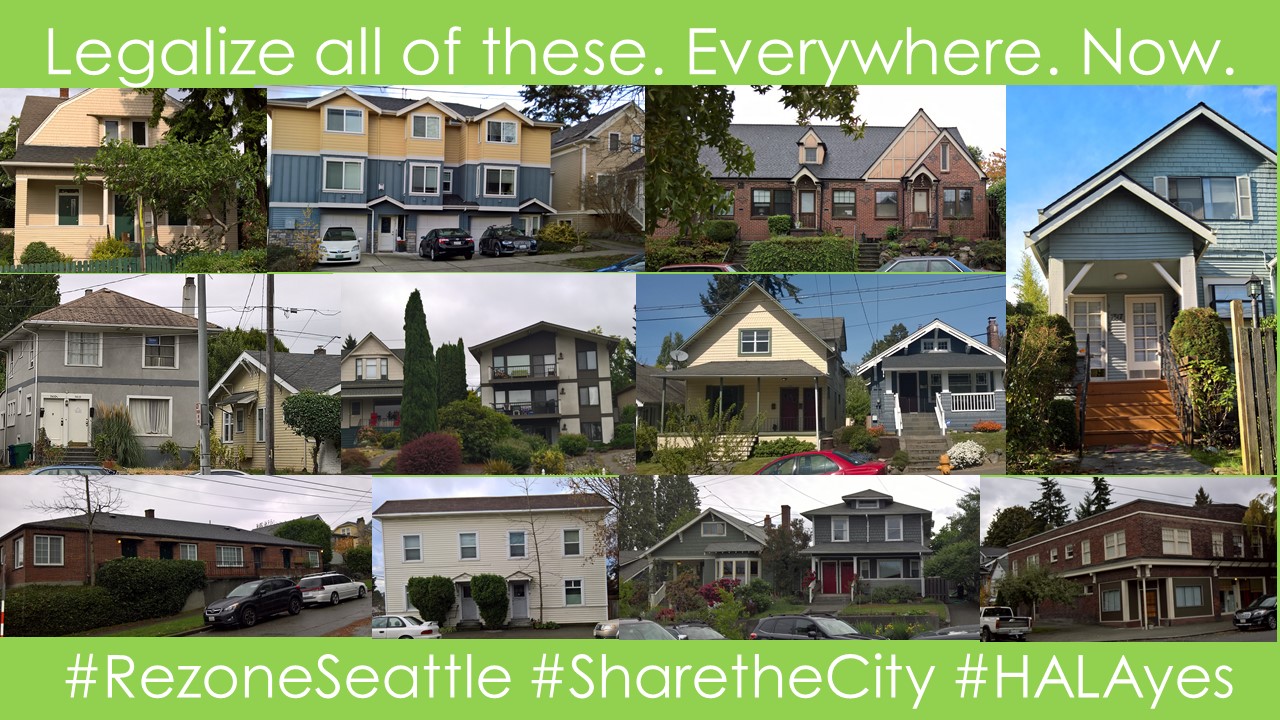
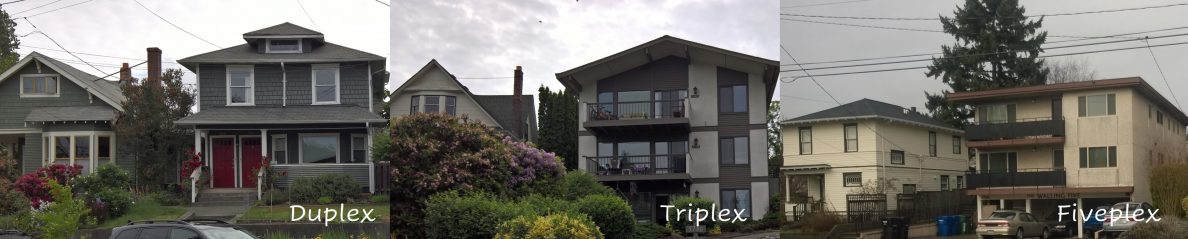
A straightforward way to allow more affordable housing options would be to retain the same basic lot coverage, height, and tree requirements while dropping the “single family home” restriction. A further step would be allowing sub-dividing large lots into sizes that were common prior to today’s zoning. Some real-world photos of multi-family housing at single family scale are here.

Here, at scale, what’s currently allowed on a 5,000SF is outlined in red.  A more typical 3,000 SF single family detached home–the only thing that’s legal today–is shown at left. Then options that are currently banned in single family zones are shown in order of affordability from “more” to “most.”

openzoning

Sources:

Seattle Times on single family teardowns


Q&A: Rezoning and urban tree canopy

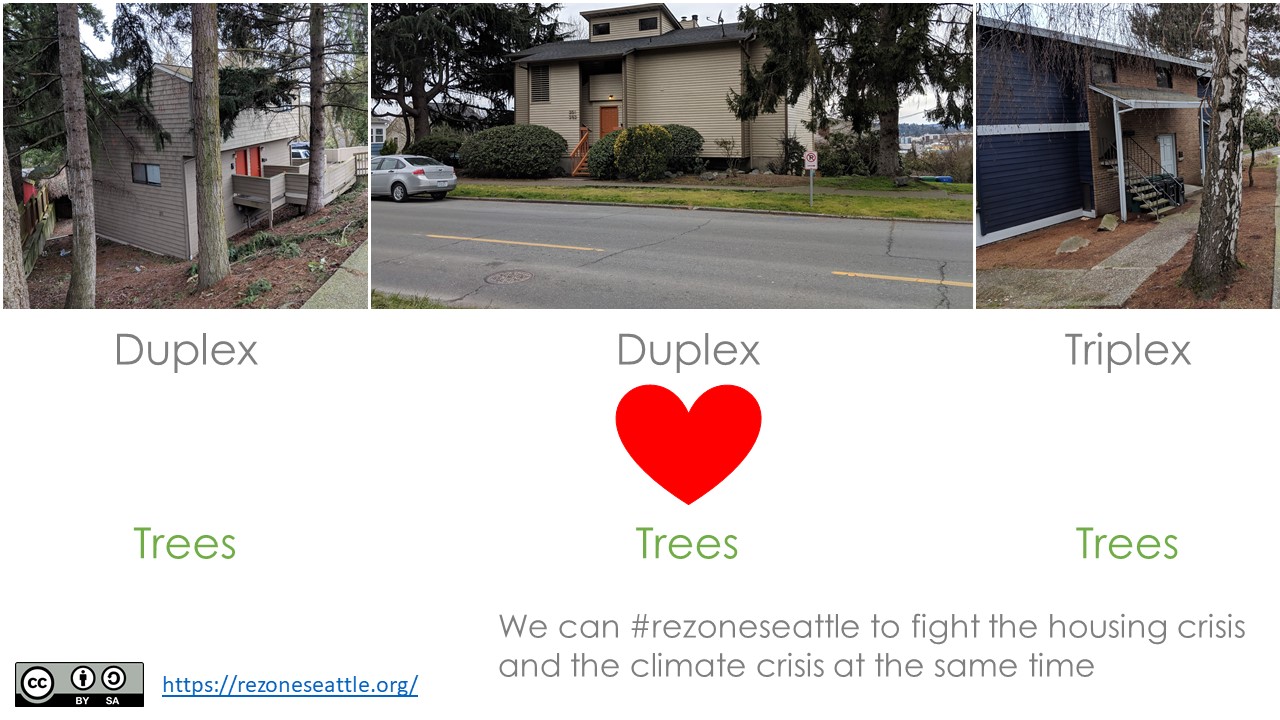
Q. Is the value I place on a  great urban tree canopy compatible with support for rezoning Seattle?

A. According to the city, in 2007 Seattle’s had about 23% tree cover. The city’s goal, established at that time, is to reach 30% by 2037. According to the city of New York and the United States Department of Agriculture Forest Service, in 2006 New York City’s urban tree canopy (“UTC”) in 2006 stood at 24%, and a study concluded that 30% by 2030 was an achievable goal.

According to an article in the Seattle Times, “If we had New York’s population density, the existing footprint of Seattle would hold 2.37 million residents.” Or to put it another way, “Pack residents of Seattle like New Yorkers, and half the city would be empty.”

There is no near-term prospect of any reason to rezone Seattle to New York density: there simply aren’t enough people who want to live here. Conversely, if we were to do so, we would be able to return large tracts of the city to forestland.

On balance, with our current zoning we are underperforming a much denser city on urban tree canopy.  The tree canopy we achieve is a question of commitment and action. Rezoning Seattle poses no barrier to bolder UTC goals than those we currently have.

Sources:

plexes_with_trees

Q&A: Why Upzone?

Q. Why is it important to upzone?

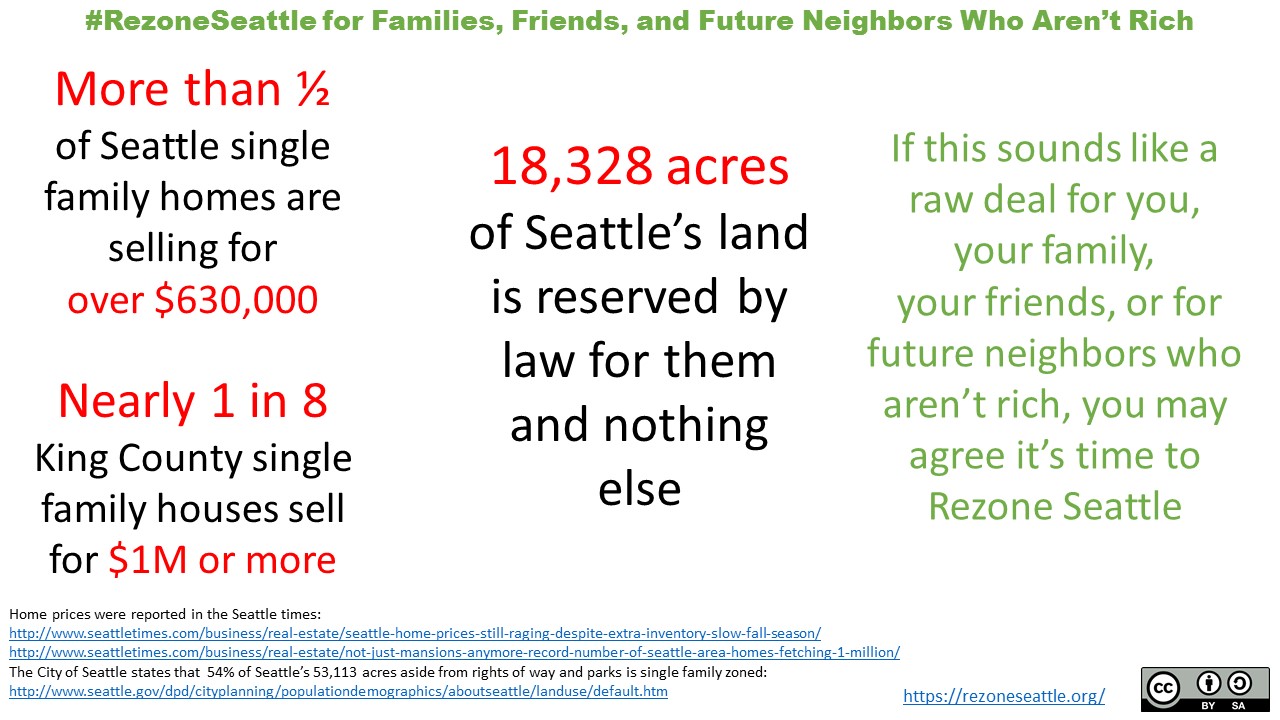
A. We can’t create more land. As more people want to live near Seattle’s many good jobs, housing will become increasingly expensive unless we allow more homes on the same amount of land.

Q. Why should I care whether people can or can’t live near jobs?

A. Reducing commutes is good for the planet. Enabling parents to spend with their kids instead of on the road is good for families and has been proven to contribute to kids’ future success. A shortage of housing near jobs reduces diversity and increases economic and racial segregation as people with more money outbid those with less, leaving the latter no option but moving away.

Q. Is upzoning being done for the benefit of property developers?

A. When President Roosevelt was fighting for changes that would helpe people afford “a chicken in every pot,” he wasn’t doing it for the sake of poultry farmers. When President Obama was expanding healthcare coverage, he wasn’t doing it for doctors.

“Zoning” is a tool in our city government’s s policy toolbox. We have to decide what we want to achieve using zoning policy. Allowing more homes on our limited land will help enable more people to rent or buy a home for themselves. Developers make their living building houses and apartments—just as farmers make a business raising chickens and doctors by providing medical care. But the reason for and goal of upzoning is to enable more people to get something they want and need. Like chickens and check-ups, someone has got to deliver the goods.

Q. Can you give me example of how allowing more and more types of housing helps?

A. Seattle is adopting a $15 an hour minimum wage. This is a great opportunity for people at the low end of the wage ladder to get ahead, provided we make living near these jobs affordable.

The city defines housing affordability as no more than 30% of income. Today according to the Center for Neighborhood Technology people here are spending, on average, a total 46% of income on housing and transportation combined (30% on housing plus 16% on transportation).

Imagine that Jamie is a dishwasher in a Wallingford restaurant.  What if we made it easy for him to find an apodment or micro-housing home with waking or biking distance of his job?

At market rates, his rent might be $900 a month.  This is $10,800 per year or 35% of his $30,600 annual income.  It’s a bit over the city’s 30% target, but if he’s spending the average of 16% of his income or $4,896 a year on transportation and he drastically reduce it (for example, by going car-free) he’s way ahead. In fact, he only needs to save $1,620 a year on transportation to make this a good option. Eliminating a daily bus commute just might do the trick for him.

Q. Why aren’t shared single family homes a great solution for Seattle and people like Jamie?

A. Imagine Jamie and 2 or 3 his friends get together as roommates to compete for single family house rentals. This puts them in direct competition with the affluent who want the houses and less affluent families struggling to find and afford multi-bedroom homes. Since single-family homes, relatively speaking, take up a lot of land per home, it is hard and expensive to make a lot more of them. And doing so would lower the number of homes possible on our limited land near jobs.

This is a situation where the rich call the tune while those with the least suffer for it.  When housing is scarce, those with the most money have the most latitude to spend more of their income to get it because they have slack in their budgets.  Once Jamie and his friends reduce what they spend on transportation as much as they can, they start cutting bone. So they either lose the home or the opportunity to get ahead. Or both.

Opening more land to more types of housing reduces this competition.

Q. What does upzoning have to do with racial justice?

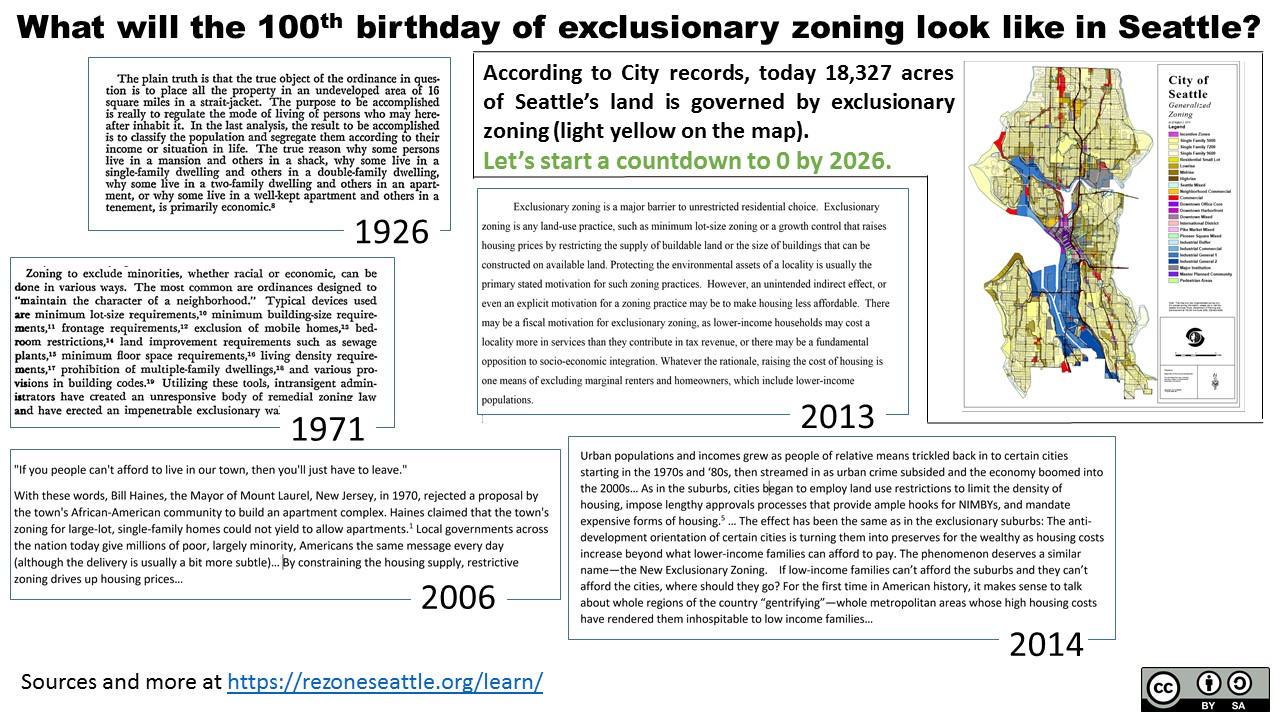
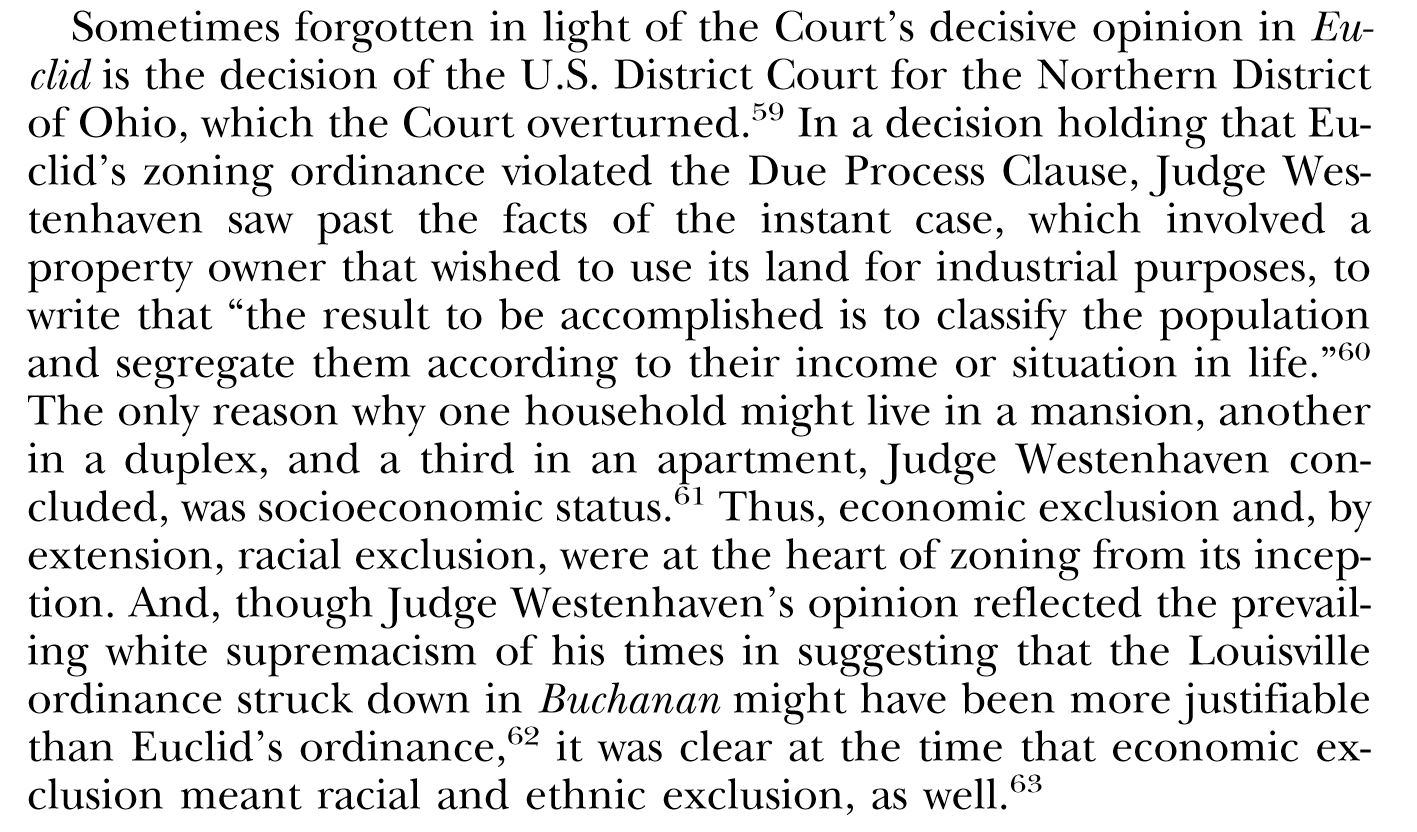
A. Because gaps in income and wealth by race persist, African-American households and others with less rather than more money are less likely to be able to afford single-family detached homes on large lots (here’s the data for who lives where in Seattle). Prohibiting multi-family housing in high access to opportunity areas, around the most well-resourced schools, and near parks and open space stacks the deck against integration and equal opportunity.

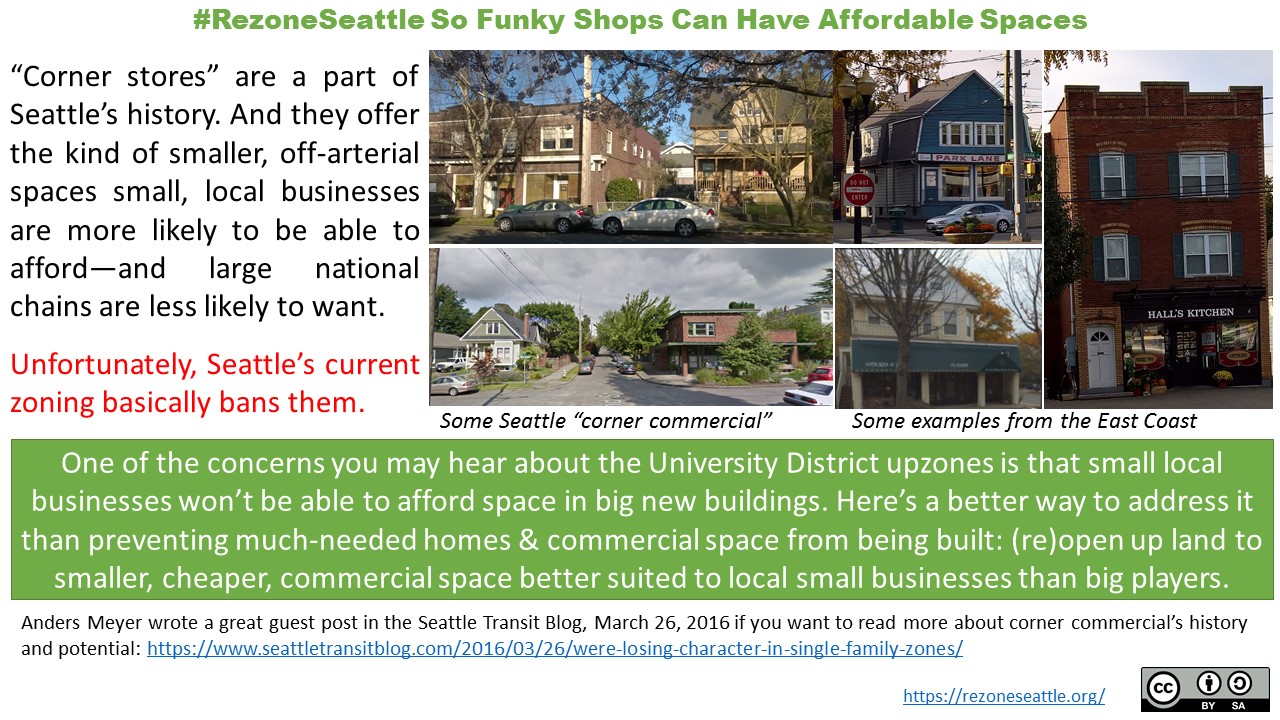
Rezone Seattle so funky shops can have affordable spaces

rezone_seattle_for_corner_commercial

Big companies are willing to pay a premium for space on major arterials because that’s how their business models work.  Local businesses who are particularly skilled, motivated   or well-resourced will be able to compete for that space too.  To enable others to have a place, we should re-open more land to small scale corner commercial space that’s well-suited to smaller, lower-margin, lower growth small businesses.  Giving them space on the corner gives those owners and aspiring owners a better shot at success.

Download PDF